

Artificial Intelligence (AI) has become one of the most transformative technologies of the modern era. From personalized recommendations on streaming platforms to virtual assistants and self-driving vehicle research, AI is reshaping industries and everyday life.
If you’re new to artificial intelligence, the subject can seem overwhelming. This guide explains AI in simple language, helping you understand its core concepts, practical applications, benefits, and limitations.
What Is Artificial Intelligence?
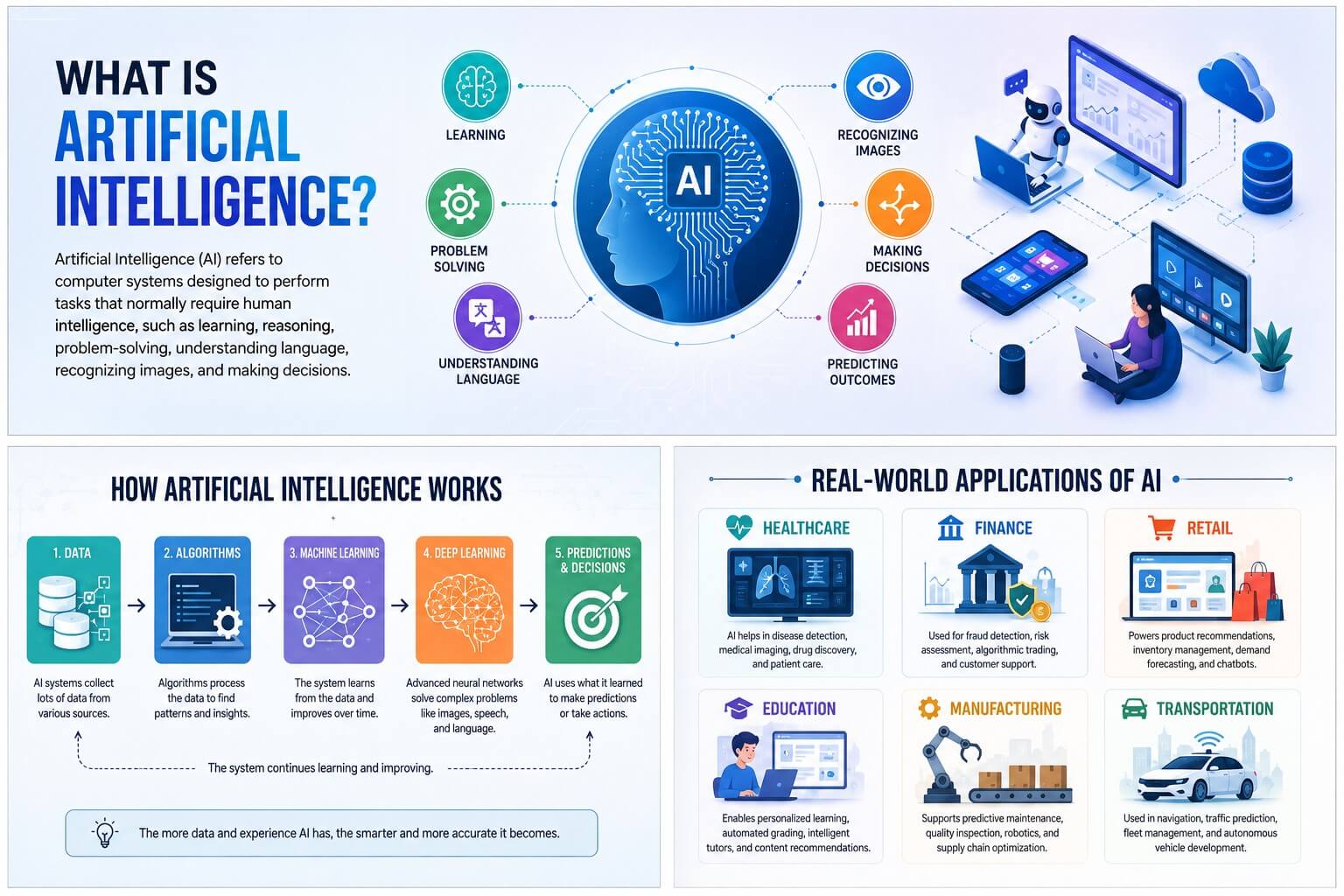
Artificial Intelligence (AI) refers to computer systems designed to perform tasks that normally require human intelligence.
These tasks include:
- Learning from data
- Solving problems
- Understanding language
- Recognizing images
- Making decisions
- Predicting outcomes
Instead of following only fixed instructions, AI systems can analyze information, identify patterns, and improve performance over time.
Simple Example
When Netflix recommends movies based on your viewing history, AI analyzes your preferences to suggest content you’re likely to enjoy.
A Brief History of Artificial Intelligence
Although AI feels like a recent innovation, its history spans several decades.
1950s
Researchers began exploring whether machines could think like humans.
1960s–1980s
Rule-based expert systems emerged, helping solve specific business and scientific problems.
1990s
Improved computing power enabled smarter algorithms.
2010s
Advancements in machine learning, cloud computing, and large datasets accelerated AI development.
Today
Modern AI powers:
- Chatbots
- Recommendation engines
- Medical imaging
- Fraud detection
- Autonomous vehicles
- Generative AI tools
How Artificial Intelligence Works
AI combines several technologies to learn from information and make predictions.
Data
Data is the fuel of AI.
Examples include:
- Images
- Videos
- Customer purchases
- Medical records
- Sensor readings
- Text documents
The more relevant, high-quality data an AI system receives, the better it typically performs.
Algorithms
Algorithms are mathematical instructions that help AI analyze information.
They identify relationships, recognize patterns, and make predictions based on previous examples.
Machine Learning
Machine Learning (ML) is a subset of AI.
Instead of programming every rule manually, developers train models using data.
Example:
An email spam filter learns which messages are unwanted by analyzing thousands of labeled emails.
Deep Learning
Deep Learning is an advanced form of machine learning that uses artificial neural networks inspired by the human brain.
It excels at tasks like:
- Speech recognition
- Image classification
- Language translation
- Medical diagnosis
- Generative AI
Types of Artificial Intelligence
Narrow AI
Also called Weak AI.
Designed for one specific task.
Examples:
- Voice assistants
- Recommendation systems
- Translation software
- Spam filters
Most AI available today belongs to this category.
General AI
General AI refers to a theoretical system capable of performing any intellectual task a human can do.
Such systems do not currently exist.
Super AI
Super AI describes a hypothetical future where AI exceeds human intelligence across nearly every domain.
This concept remains speculative.
Real-World Applications of Artificial Intelligence
AI is already integrated into many industries.
Healthcare
AI assists healthcare professionals by:
- Detecting diseases from medical images
- Supporting diagnosis
- Accelerating drug discovery
- Predicting patient risks
Finance
Financial institutions use AI for:
- Fraud detection
- Credit scoring
- Risk assessment
- Automated trading support
- Customer service chatbots
Retail
Retail businesses use AI to:
- Recommend products
- Forecast demand
- Optimize inventory
- Improve customer support
Education
AI helps personalize learning through:
- Adaptive learning platforms
- Automated grading
- Language tutoring
- Virtual teaching assistants
Manufacturing
Manufacturers leverage AI for:
- Predictive maintenance
- Quality inspection
- Robotics
- Supply chain optimization
Transportation
AI contributes to:
- Navigation systems
- Traffic prediction
- Fleet management
- Autonomous vehicle research
Benefits of Artificial Intelligence
AI offers advantages for individuals and organizations alike.
Increased Productivity
AI automates repetitive tasks, allowing people to focus on higher-value work.
Better Decision-Making
AI analyzes large datasets quickly, helping identify insights humans might overlook.
Improved Accuracy
When properly trained and monitored, AI can reduce certain types of human error.
Personalization
AI powers personalized recommendations for shopping, entertainment, education, and marketing.
24/7 Availability
AI-powered assistants and chatbots provide continuous support without requiring breaks.
Challenges and Limitations of Artificial Intelligence
AI is powerful, but it also presents important challenges.
Data Quality
Poor-quality data can lead to inaccurate predictions.
Bias
AI systems may reflect biases present in their training data, resulting in unfair outcomes.
Privacy
Organizations must protect sensitive information when developing AI applications.
Lack of Human Judgment
AI cannot replace human empathy, ethics, creativity, or contextual understanding in many situations.
Cost
Building advanced AI systems often requires significant computing resources, expertise, and ongoing maintenance.
AI Myths vs Facts
| Myth | Fact |
|---|---|
| AI thinks like humans | AI identifies patterns using mathematical models. |
| AI will replace every job | AI is more likely to automate specific tasks while creating new roles. |
| AI is always accurate | AI can make mistakes if trained on poor or biased data. |
| AI only benefits large companies | Small businesses increasingly use AI tools for marketing, customer support, and productivity. |
| AI is magic | AI relies on data, algorithms, computing power, and human oversight. |
How Beginners Can Start Learning AI
You don’t need a computer science degree to begin learning AI.
1. Learn Basic Concepts
Understand:
- AI
- Machine Learning
- Deep Learning
- Neural Networks
2. Improve Math Skills
Focus on:
- Statistics
- Probability
- Linear Algebra (basic understanding)
3. Learn Python
Python is one of the most widely used programming languages for AI development.
4. Practice with Small Projects
Examples include:
- Image classification
- Sentiment analysis
- Recommendation systems
- Chatbots
5. Follow AI News
AI evolves rapidly. Reading trusted research, educational resources, and official documentation helps you stay informed about new developments.
Frequently Asked Questions
Is artificial intelligence difficult to learn?
No. Beginners can start with basic concepts before exploring programming, mathematics, and machine learning.
What’s the difference between AI and machine learning?
Artificial intelligence is the broader field. Machine learning is one technique used to build AI systems that learn from data.
Do I need coding skills?
Not initially. Understanding AI concepts comes first, though programming becomes valuable for building AI applications.
Is AI replacing human jobs?
AI automates certain tasks, but it also creates new opportunities in software development, data science, AI governance, and other fields. Many roles are evolving rather than disappearing.
Can small businesses use AI?
Yes. Many affordable AI tools help with customer service, marketing, analytics, content creation, and workflow automation.
What industries use AI?
Healthcare, finance, retail, manufacturing, transportation, education, agriculture, entertainment, cybersecurity, and many other sectors use AI in different ways.
Conclusion
Artificial intelligence is transforming how people work, learn, communicate, and solve complex problems. While the technology continues to evolve, understanding its fundamentals provides a strong foundation for future learning and informed decision-making.
For beginners, the best approach is to start with core concepts, explore real-world examples, and gradually build practical skills through hands-on projects. AI is not just for researchers or developers—it is becoming an essential part of everyday life and a valuable tool across nearly every industry.